Interview with Karyn Crisis and Afzaal Nasiruddeen of Crisis
by John Haseltine
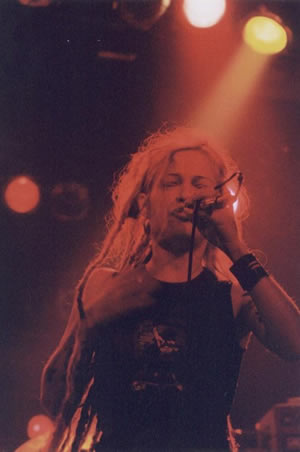
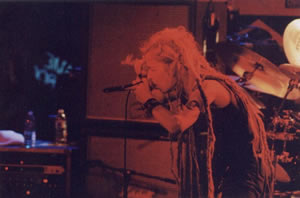 After the long haul from one coast to the next. The long search for the perfect drummer and a label who would be supportive and understanding of the artistic musicianship that is known as Crisis. The band is back with a new album, ‘Like Sheep Led To Slaughter’ on The End Records. Currently on tour with Soulfly and Ill Nino in support of their latest effort, I had a chance to catch up with Karyn Crisis and Afzaal Nasiruddeen.
JH: Okay, for the new fans as well as the old, gives us a brief history of the band.
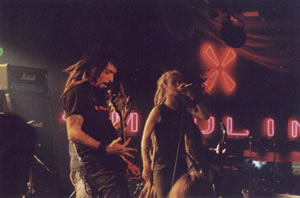
KC: We started back in 1993, we put out our first album which was a complitation of our demos at that time period called ‘8 Convulsions’, it came out in 1994 on 2 Damn Hype Records, and it was just re-released thru Martyr Music Group as a ten year anniversary re-release package with new artwork and photos. After that we put out two releases on metal Blade Records, which brings us to 1997. We put out Deaths Head Extermination in ‘96 , The Howling in ‘97, and we’re known as a touring band who’ve toured and toured and toured. All in the underground level. But we did tour. After The Howling came out we fired Metal Blade and we moved around the millennium to the west coast, to California in search of a new label. Our plan was this time that if we could not find a label to start our own label. Which we really did although we did find a label in The End Records. So we started our own label in conjunction with them called ‘Children Of Rage’ which brings us to our brand new album called’ Like Sheep Led To Slaughter’. so that’s our album history. We pretty much got our reputation as a live band, cause we have a pretty dynamic show. Of course back in ‘93 we were doing something that was really different. We broke all the rules. Having me as a front person in a really heavy band, and since then we’ve really just built our reputation in the underground. This is really the first tour we’re doing that kinda on a different level for us. We’re breaking in mainstream kids who don’t know of us or really know a lot about the underground. You can add any details?
 AN: That’s good. You got it all.
JH: Crisis disbanded for a few years. What was the reason for this?
AN: Well, after we moved to Los Angeles, around the millennium, all five of us moved, including our drummer from New York, after a few months our drummer decided he didn’t like L.A. at all. He wanted to move back to the east coast . So he actually ended up moving down south and joined Crowbar. We ended up trying to find a new drummer, we had a really tough time being on the west coast, the music scene is so different from what we’re used to. It’s much trendier . Most of the drummers we talked to wanted to be in their next favorite band, which was successful at that time. We’re not one of those bands that really copy anybody, so it wasn’t easy finding a drummer. So we decided to just chill out and write music on our digital eight track and just have a good time drinking, writing and playing our songs. We ended up changing our name for a little while. Went under a different moniker, wrote about twenty or thirty songs. Just for the fun of it. Than we sort of got the itch back to do Crisis again. We ended up finding a drummer in L.A. who was from the east coast. he’s in the band now. His name is Josh. He’s from Baltimore. He was an old time Crisis fan so he knew a lot of our songs already. He just fit in really good. Since we found him things have just really flowed. We recorded the album. Self financed the album. Got our producer Billy Anderson who is an old friend of ours, who’s done a lot of major underground bands like Neurosis, Fantamos, Mr. Bungle. He ended up just coming down, crashing out on our couch and recorded the album for us. We payed for it our selves. We actually recorded about eighty percent of the record ourselves with our own money, than we let some people listen to it. We met Andres at The End Records, through some mutual friends of ours, who had highly recommended him. Turns out he is an old time Crisis fan, wanted to make us a priority, and we were more interested in being on a smaller label that treated us seriously, then being on a big label were you just get lost in the shuffle. So we went with The End Records as a result and things have been going great.
 JH: So then you feel it was a good break now?
AN: Yes I think so. I think the break was meant to be. You can never really predict why the break happened or what happened. We just followed our instincts, and our instincts led us to where we are now.
JH: So what was the deal with Metal Blade? What happened there?
KC: It was soft of the typical scenario. When we got signed, the guy who was our A&R guy who singed us to the label, left, I mean right after we signed our contract, and went to Century Media. So the guy who was our cheerleader at that label was gone.
AN: We hadn’t even gone into the studio to record the album when he left Metal Blade.
KC: And it was a situation where a lot of the people who worked there liked us, but the head cheese really didn’t get us at that time. We were a band who, if you notice bands are constantly touring , there all about the touring. Back then we wanted to tour all the time cause we saw as a heavy band, that was the best way to sell yourself. Because the Headbangers Ball had went off the air, there was just college radio, there weren’t the magazines.
 JH: It would have been tough to fit you in between Great White and Motley Crue.
KC: Exactly, and there weren’t that many ‘zines and the internet was not like it is today. So there were a lot of things where we were just too ahead of our time for them to understand us I guess. And it, we were just promised a lot that never came thru, on pretty much everything and it was a situation where we just decided that we would rather be on our own,
AN: And not put out another record.
KC: And not put out another record , or just jam. Cause our music comes from just the joy of making music. But, we rather be on our own than be promised something and fell like someone else is holding our dreams back. We were, are a really ambitious, hard working band. We want to work with a label not for a label. We don’t not want to have our phone calls not returned, or whatever it is that it takes. We just weren’t getting the support. And we felt like we could just stay here and keep preaching to the converted. Playing these big shows here, small shows there, never get to certain territories where people wanted to see us. Or we could take the risk, get rid of everything we have, go to another coast and start from scratch. We felt for the sake of our own survival we had to do that.
 JH: That’s something I hear a lot. A band up rooting from one area for another for the sake of the genre of music they are in.
KC: Well yea, there are a lot of other areas we would love to live, we never really saw ourselves living in L.A. It’s not really our kind of town, but the industry is there. They’re out on the streets. They’re very accessible, New York it was a situation where we were selling out shows, we were headlining, we could book our tour pretty much anywhere on the east coast and mid west where ever we wanted to. But, labels weren’t interested. They said we were too extreme, too weird, you don’t have any marketability cause you have a woman. It was these sort of things, and we were like, that can’t be possible because people come to our shows. So there’s something out of sync there. So we figured we would go where the business was because all of these bigs tours that were going on were coming out of California, you know bands that no one had ever heard of on the east coast. Korn came out of the middle of no where, The Deftones popped out of thin air. So we were like lets go see what’s going on there. And how these things are happening. As it ends up our label is from Salt Lake City, but ‘round about through all this experience it got us to where we are today.
JH: So how is it with The End Records so far?
KC: It’s great. It’s like the opposite of what we didn’t have before. You know we deal with them, talk to them everyday, to the owner. We’re right there. It’s almost like we have a label at our disposal, in a sense that we work together. And that’s the most you can ask for from a label. They’re a smaller label right now. They are growing, so we’re still operating on a smaller level. But we’re operating with enthusiasm, on their part, total cooperation. We work on battle plans together, which is really exciting. As a band, that’s the best situation to be in. That you can have.
JH: So after you made the big move, the moniker you went under was ‘Skull Sick Nation’, of the many songs under that band, are there any that you ever play as Crisis?
AN: No. It was a transitional period for us. There were a bunch of demos. We were experimenting with different types of song structures, and it really wasn’t Crisis. It was a different concept. We wanted to stay true to what we were doing at the time. We changed our name because it did not sound like Crisis. So to play Skull Sick Nation songs as Crisis wouldn’t make any sense. They have a different vibe to them. Completely different feeling, different atmosphere so , if anything, we might release the Skull Sick Nation stuff , the demos as Skull Sick Nation. As unreleased stuff, but playing them at a Crisis show does not make any sense to us.
JH: So what brought about the reformation of Crisis?
KC: Well it was something that we always wanted to do, I never really wanted to be in any other band but Crisis. It was home for me, we developed our own world there. But as Afzall said earlier, life takes you on it’s twists and turns and we’ve never been one, I mean musically to follow the journey to where it takes us. You know that this album is gonna sound like this, and this album will sound the opposite of or, what ended up happening is we dove into that journey whole heartedly and it all came to a point where we felt like we were at the end of that journey. We all did at the same time. For different reasons. We all were like ,we need to go home. Which was Crisis. But there were the obstacles of finding the right drummer which has always been the vein of our existence since our first drummer left. Weather it was finding the right guy with the technical skills, the right passion, it was a whole combination that we found in Josh, that we hadn’t been able to find all those years. So we finally decided to give it another try. Let’s put the hooks out there and see what we can real in, as far as a drummer goes and it ended up working out.
JH: So you changed up you sound a bit on this latest release? How would you describe the sound of your latest release to that of the earlier Metal Blade releases?
KC: Well all of our albums have this core Crisis vibe. Which is odd time signatures, a little bit of mid-eastern flavor, dynamics, and my whole vocal range is very dynamic. I don’t just growl like the guys or howl like the girls, I like to mix it all up. But everyone of our albums has a different flavor to them. Like 8 Convulsions has a different flavor from Deaths Head. Which people consider a little more death metal were as The Howling is a little more doomy. We all feel as though this album is our best effort to date. It pretty much combine all of our best traits that all of our other albums have exhibited. And it’s culminated into the strongest collection of songs we feel right now. You would have to judge for yourself after hearing it. So that’s our opinion.
JH: Can you tell us a little bit about it?
KC: You mean sonically?
JH: Yea.
KC: Lyrically I would say it’s still say it has the same Crisis vibe with the apocalyptic person ideas, but we also , I went into the social realm, sort of the political realm. I always like to deal with symbolism. I don’t ever try to preach or beat you over the head with what I’m trying to say. I like to leave room for interpretation. So I would have to say the album is an evolution of all our years of experience.
JH: How was it recording as Crisis again?
KC: It was fantastic. I felt like we had never feel off the wagon. We really feel like we’re the strongest unit today. Part of it is the experience we went through with Skull Sick, just experimenting with the song writing. Part of it was finally finding the missing link which was a drummer. When you have someone in the band that’s really not on the same page as you, or not quite as enthusiastic, or open, you know the experience is a little less powerful because they say you’re chain is only as strong as your weakest link. So not only is everyone, the original members, then our newer additions, on guitar Jwyanza who’s been in the band for the past six years, stronger than ever. On a personal level and a musical level. And now we have a drummer who’s right there with us. So, it’s really been a great experience. We’ve always enjoyed being in the studio.
JH: The album layout is pretty much all your concept and artwork?
KC: Yea, I always do all the artwork.
JH: Not only artistic musically ,but also into painting, photography, sculpting? Besides the band this is what you do on the side?
KC: Yea, that and I have an accessories company where I make belt buckles and leather accessories and necklaces.
JH: I checked it out. It’s pretty cool. The stores closed while your on tour.
KC: Yes it is while we’re on the road. Thanks for reading.
JH: You have a video out for the song ‘Blood Burden’. has it been getting a fair amount of play?
KC: It had been. I’m not sure as of late how it has been doing. It got some really great spins and some really good reactions. We got flooded with e-mails from people.
JH: What went into the making of it? The concept and all.
KC: Well I got a friend of ours from back on the east coast. What happened this time is when we got Crisis back together, a lot of people that we knew from the record industry, specifically from back east who were big fans of ours, came to our aid. They helped us out. Whether it was our video marketing guy, or helping us find our label ect.,ect.,ect. And what happened was the president of the marketing company we hired, he used to come to shows and film our shows before he started his company. He threw out the name of Darren Done (sorry Darren if I‘ve misspelled your name), the video director. So I got in touch with Darren, he said he was a fan. And we kind of combined our visions for what we had for our first video, which was trying to capture the essence of our live show, along with some of the crowd energy and reaction. So that’s where that came from.
JH: Okay only a couple more for you.
KC: Oh, that’s alright. Keep asking.
JH: So how has the tour with Soulfly been going so far?
KC: It’s been going great. It’s been very consistence for us every night. The crowd like, you know like I said earlier, I don’t know if we were on tape or not, we went into this tour knowing it was more of a commercial tour and audience. A lot of the kids, depending on the territory, are not so into the underground. So it’s like a whole new fresh audience for us. So we’ve been loving the challenge of a new audience. That’s always fun. Yea, but it’s been so great every night, the crowds are so enthusiastic , been doing great with merch, we like to hang out at the merch booth after and meet fans old and new. So it’s been awesome. And Soulfly has been taking great care of us while on tour. We’re having a great time.
JH: Being the first band on the bill for most of the tour, how have the crowds been fro you?
KC: Yea, we were the first band on the bill till Twelve Tribes jumped on so they’re the first band now. If you are the first band, you always have to go into it cold, you know you’ve got to warm people up. What we usually find is that for the first song or two people are like, staring, fixated on the stage. And then everyone starts rockin’ out. Or what ever they do. We’re not a band that feels we have to have a pit every time we’re on. Although we have plenty of those. Our job, we feel, is to make people think. To think how ever they want. If they want to jump around, if they want to stare at the stage. What ever it is.
JH: Well the diehard Crisis fans are thrilled you’re back. What seems to be the reactions of those people seeing, or rather hearing you for the first time?
KC: Well one thing that is really cool is that people have been apologizing for not knowing about us sooner. They’re like , why don’t we know about you, you’ve been around for over eleven years. We’re sorry. Total enthusiasm and it’s been great. every night we’re flooded with tons of people at the merch booth, they’re super excited. We make sure we get their e-mail address. They can’t believe what they just saw. So they’re really excited about it. So it’s been cool.
JH: So I hear through the grapevine you’ve got another tour lined up after this one with Otep and Kittie? Can you confirm this for us?
KC: Yea. That one starts about six days after this one ends.
JH: So that’ll be in the U.S.?
KC: There will be some Canadian dates also.
JH: Is there a European tour lined up?
KC: Yea, we have a few offers in the works right now around January or February. We’re trying to decide what we want to do right now. So that’s cool.
JH: What do you want people to get out of your music?
KC: I’m not really going to tell you what you should get out of it. We’re a band that whether you’re talking 1993 or 2004, we really don’t fit in anywhere. And we really are still breaking the rules. You can’t really categorize us. You know, even though we’re doing a tour with all female fronted bands, we don’t have anything in common with them. Except for our gender. Musically, we’re really doing something way different then what is trendy at the moment. You’re not going to hear the current language, the current musical heavy vocabulary in what we do. We’re more about , like when we go in to write songs, we just open ourselves up and dig super deep, and we try to use some catharses with the music. You know, staring your demons in the face. Getting something positive out of it. We really bare in ourselves, we’re completely open when we’re jamming. So you may get something out of it that scares you, you may get something out of it that makes you think that’s too awkward, and ugly I don’t like it. You may find it one of the most uplifting things you’ve ever seen. It’s up to you. Ultimately we do this for ourselves. The second thing we do it for is the sake of communication. We love, you know that’s what music’s about. It’s about reaching out and touching people. Whether they accept it or not is not up to us. It’s up to whatever you decide. And we’re fine with that. We feel it’s our job to offer a true alternative. And that’s what it is. It’s either your celebration, or whatever it may be.
JH: Well it’s been a real pleasure talking with you, and I thank you for your time. Is there anything you would like to add?
KC: Thanks for the support. Thank you for waiting around for me and your patience.